


Cybersecurity for small organisations
Empowering small organisations to tackle the exponential rise in cybercrime

In collaboration with:

Vaud Cantonal Police
Protecting small organisations from growing threats
Protecting small organisations from growing threats
This call for proposals aimed to stimulate collaborative innovation in order to develop solutions to strengthen the digital security of small organisations, such as SMEs and local authorities, covering everything from risk assessment to intrusion analysis. It was carried out in collaboration with the forensic unit of the Vaud Cantonal Police.
The aim was to contribute to the development of technological building blocks and the creation of disruptive methods and tools for security assessment, prevention, detection and analysis of vulnerabilities and intrusions.
Funding available

CHF 100,000
by project
Submission deadline

31.05.2024
Discover the innovations resulting from this call for proposals

IRIS
Recently, several municipalities in the canton of Vaud have been affected by cybersecurity incidents.

WATCHDOG
Many SMEs are at a loss when faced with the scale and complexity of cyber threats

Fighting phishing
There’s no denying that phishing is wreaking havoc.
From idea to funded project
A clear roadmap for turning an idea into a structured collaborative project.
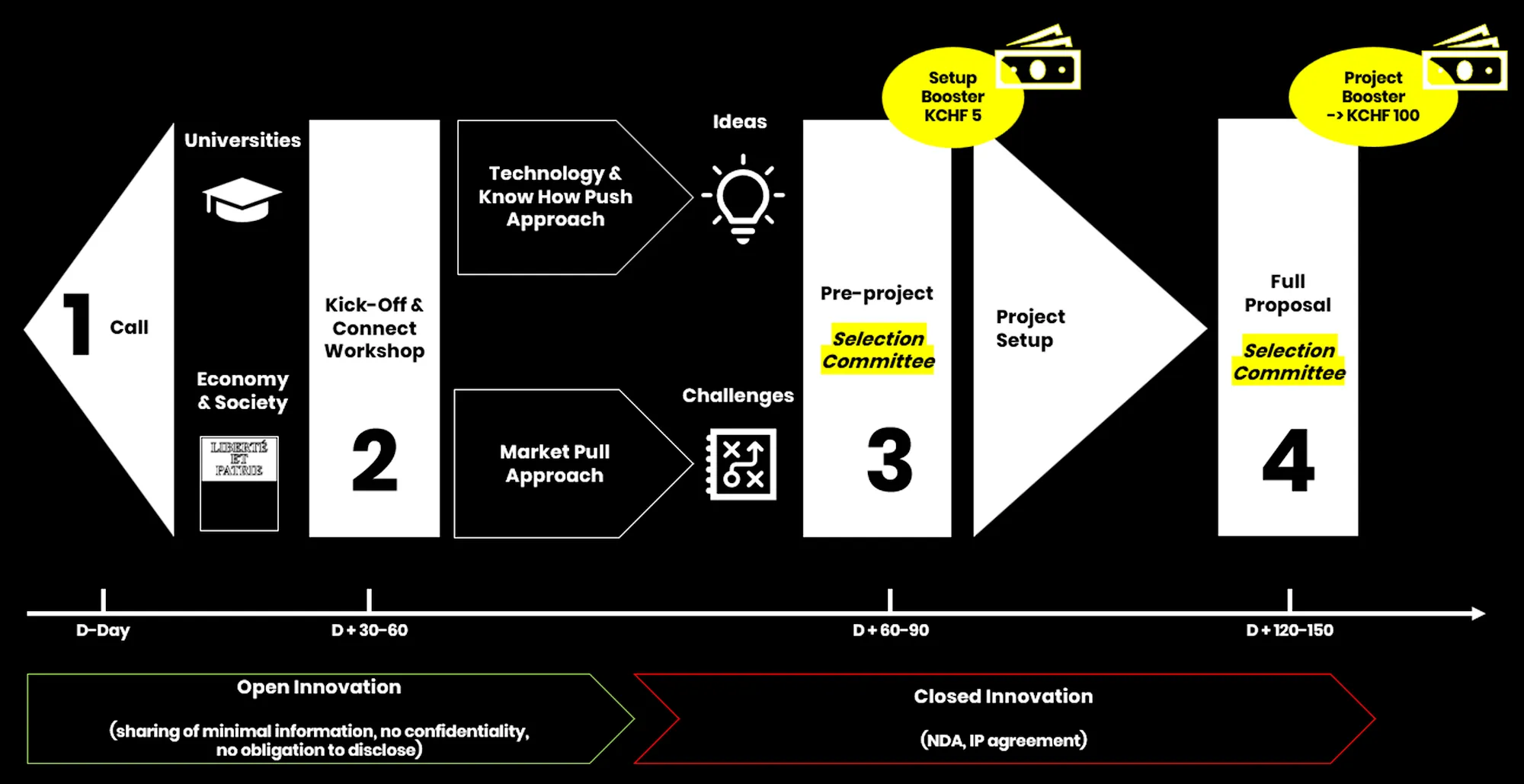
Suivez notre calendrier
- 31.01.2024 – Call for proposals opens
- 05.03.2024 – Kick off Workshop
- 18.03.2024 – Deadline for applications for Idea Boosters
- 02.04.2024 – Deadline for submitting ideas (1-page summary + 2–3-minute video pitch)
- 12.04.2024 – Allocation of Setup Boosters
- 31.05.2024 – Deadline for project submissions
- 14.06.2024 – Selection of projects and allocation of funding
- 31.09.2024 – Deadline for starting projects
- 31.09.2025 – Deadline for project submissions
- 10-11.2025 (to be confirmed) – Event to showcase projects

Call
Find out about the theme, the issues involved and current topics. Take a look at the timetable for the call for proposals.

Kick-off & Connect Workshop
Meet the community, share your knowledge and identify potential partners.

Preliminary draft
Back up your idea with a one-pager and a 3- to 5-minute video to try and secure a CHF 5,000 grant. Ideal for getting your partners on board and getting the project off the ground.

Final project
Submit your application in the form of a dossier of no more than 10 pages to apply for funding of up to CHF 200,000.
Check that your project is suitable
Your project must meet the following criteria to be eligible for the [seal] programme.
Amount of financial support
Up to CHF 100,000 per project
Project duration
6 to 12 months
Allocable costs
Internal staff and equipment costs incurred by academic partners and implementing partners.
Funding rate
Up to 90 per cent of eligible costs
Conditions
- Involvement of at least two academic partners and one implementation partner based in the canton of Vaud.
- An applied innovation initiative offering the potential for direct benefits for the socio-economic fabric of the Canton of Vaud.
- Results that can be utilised and made publicly available.
Got an idea in mind? Activate your Booster
Set out your idea in the form of a preliminary proposal consisting of a one-pager and a video lasting 3 to 5 minutes.
If the Selection Committee approves your preliminary project proposal, you will receive a lump-sum grant of CHF 5,000 to engage your partners and set up the project.
Your efforts will be rewarded, regardless of the outcome of your application.
Setup Booster CHF 5’000
Please contact us as soon as possible after the launch event to apply for your Booster.

Collaborative, practical and testable projects
The [seal] Programme supports applied innovation projects in the field of cybersecurity and digital trust.
Projects may focus on the development, testing or implementation of technological prototypes, innovative business tools, methodologies or new professional practices.
Proposals must bring together academic expertise and implementation partners capable of testing, evaluating or rolling out the results in a real-world context.
Where can you find us?
Please contact the Vaud Cantonal School of Engineering and Management (HEIG-VD), which is responsible for implementing the Programme’s activities.
We guide you in identifying your specific points of contact and support you in building your partnerships.

Center for digital trust

Y-Security

School of Criminal Sciences
Frequently Asked Questions (FAQ)
Which laboratories, institutes and research groups can submit or take part in a [seal] project?
The [seal] programme is aimed at members of the EPFL–UNIL–HEIG-VD consortium. Every laboratory, institute and research group at these three institutions is eligible to take part in the projects. The programme is therefore not restricted to specialists in digital trust and cybersecurity, but is open to any field that requires these skills.
Within an academic institution, who can lead a [seal] project?
Provided they comply with their respective internal rules and practices, all staff members at the three academic institutions (EPFL, UNIL, HEIG-VD) may submit a project and act as its project leader. The programme is therefore not restricted to professors. Research staff, research officers and research assistants, postdoctoral researchers and PhD students are also eligible.
HTML
What does it mean to be a project leader?Que signifie être porteur de projet ?
The project leader is the point of contact for the project in relation to the [seal] programme. They take on the role of overall coordinator, as well as acting as a financial and communications liaison. However, this does not mean that they must be the main contributor to the project.
What types of human resources can academic partners draw upon within the framework of a project?
All roles (lecturers, postdocs, PhD students, teaching assistants, etc.) may be remunerated at their respective rates, provided their contribution to the project is deemed relevant. It is also possible to contribute through a supervised student project (such as a Master’s thesis).
What additional sources of funding can academic partners tap into?
Other sources of funding are, in principle, welcome (academic structural funds, national funds, foundations, contributions from industry). They must be disclosed in a transparent manner.
HTML
How can [seal] funding complement a longer-term (basic) research programme?
[seal] funding may be considered as one-off supplementary funding for a research project, enabling the application of interim results (proof of concept, prototype, pilot, proof of value). In this context, it may be used to cover part of the salary of a PhD student or of staff recruited specifically for the project.
At what rate are working hours paid?
Academic partners apply their Innosuisse hourly rates. The hourly rate for implementation partners (companies, non-profit organisations, public sector departments) shall not exceed CHF 150.
What is the role of an implementation partner?
In principle, the implementation partner(s) play a very active role in the design and development of the project and account for a substantial proportion of the costs. It is, however, possible to assign them a more advisory role (strategic direction and decision-making, feedback from the field, economic positioning, user testing).
Can the [seal] funding also cover the costs of implementation partners?
Yes, up to 70 per cent of the staff and equipment costs incurred by implementing partners (companies, non-profit organisations, public sector bodies) may be funded. The costs incurred by academic partners, meanwhile, may be covered in full by [seal].
Are implementing partners required to make a cash contribution?
No, implementing partners may limit their contribution to in-kind contributions (human and material resources) amounting to at least 30 per cent of the costs attributable to them.
Quelle est la contribution minimale des partenaires d’implémentation ?
No minimum contribution has been set. Funding [seal] is limited to 90 per cent of the project costs, but the remaining 10 per cent may come from sources other than the implementing partners.